"Voltage/Capacity/Energy Density: Only by understanding the three most crucial parameters of lithium batteries can you truly understand battery performance!"
1. Voltage: The "blood pressure" of a battery, determining the limit of energy output
"Core Concept
Voltage: The potential difference generated by the movement of a unit charge within a battery, which directly affects the power supply capacity of the device
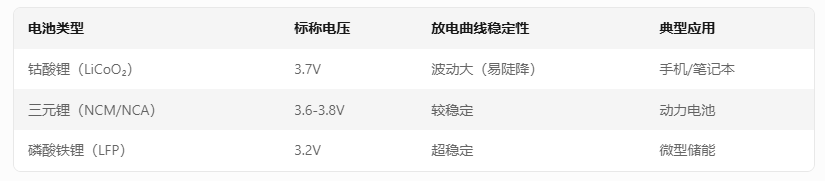
Nominal voltage: The voltage at which the battery operates normally (such as a 3.7V lithium battery)
Discharge cut-off voltage: The minimum voltage at which a battery can be safely discharged (typically 2.5-3.0V)
【 Fatal Misconception
Is higher voltage equal to stronger energy?
"Wrong!" Voltage only reflects the intensity of a single discharge. Actual energy = voltage × capacity (Wh)
Comparison: 5V/2000mAh=10Wh VS 3.7V/5000mAh=18.5Wh
【 Real Case 】 Crash of a certain brand of drone in 2019:
The nominal voltage of the battery was falsely marked to 4.2V (the standard is 3.7V), and continuous discharge caused the electrolyte to boil and explode
Ii. Capacity: The "capacity" of a battery determines the essence of its battery life
"Core Formula
Capacity (mAh) = Discharge current (mA) × time (h)
"In-depth Analysis
Capacity test standard: 0.5C discharge: Discharge at half the rated capacity current to the cut-off voltage (for example, discharge a 1000mAh battery at 500mA)
Low-temperature capacity attenuation: At -20℃, the capacity of lithium iron phosphate drops by 40%, while that of ternary lithium only decreases by 15%
The "false labeling" trap
Test Results of the best-selling power bank on Taobao
The nominal capacity is 20,000 mah, but in reality, only 6300mAh is produced when discharged at 0.5C (with a false labeling rate of 63%)
→ Key indicators: Check if "mAh@2A" or "20W output "is marked.
The game between capacity and lifespan
Deep charge and deep discharge vs. shallow charge and shallow discharge
Comparison of capacity retention rates after 100 complete charge and discharge cycles:
Deep charge and discharge: 65%
20%-80% range charge and discharge: 92%
Iii. Energy Density: The "slimming champion" of batteries, determining the portability of devices
"Core Formula
Energy density (Wh/kg) = voltage (V) × capacity (Ah)/mass (kg)
Iv. A Must-Read Parameter Selection Guide for Consumers
For mobile phones/tablets: Prefer a battery capacity of 4000mAh or above and a voltage of 3.8V or above
Be cautious of batteries with a capacity of less than 20,000 mah and a voltage of less than 3.2V (mostly low-end cells)
Electric bicycles: Pay attention to energy density above 60Wh/kg (the new national standard requires ≥50Wh/kg)
Choose 18650 battery cells
Power bank: Calculate the actual energy: Capacity (mAh)× voltage (V)/1000 → 20000mAh/3.7V=74Wh
Civil aviation restrictions in 2023: Passengers with a capacity of ≤100Wh can board the plane directly, while those with a capacity of 100-160Wh need approval from the airline
Voltage is the "vital sign" of lithium batteries, capacity is the "appetite", and energy density is the "body shape". By understanding these three parameters, you can see through the promotional rhetoric of merchants and make wiser choices. When solid-state batteries break through the energy density bottleneck, perhaps we will witness a true energy revolution - after all, whoever can master the balance of these three parameters will grasp the lifeblood of the technology industry in the next decade.